Showing posts with label #Alamo. Show all posts

Sunday, August 29, 2021

Sanitizing history


There’s an old saying that most of us have heard a thousand times, with a hundred variations: Who doesn’t know the past is doomed to repeat its mistakes. If we don’t study history, we’ll bring ourselves down by repeating the follies of earlier generations. It seems, though, in our rush toward patriotism, that bit of advice is being left behind. But that’s not new.

I read today that schoolchildren are not being taught about the Trail of Tears, the forced removal of about 60,000 Native Americans from Florida and the Deep South to Oklahoma in the mid-nineteenth century. Instead of being taught how the people of the Cherokee, Muscogee (Creek), Seminole, Chickasaw, and Choctaw nations were marched under guard, with many dying, school children are told that the Indians agreed to move to make room for new settlement. A blatant and horrible distortion of the truth. They were moved to make way for white greed.

Similarly, at least one textbook informs children that Africans came here as “workers”—no mention of slave ships, slavery, cruel overseers, families torn apart. I suppose children are also not being taught about the internment of Japanese citizens during WWII. Another big blot on our history. I’m reading a novel called Clark and Division right now—the title being the name of an intersection on Chicago’s North Side, in a community where many Nisei (first generation) and Issei (born in Japan) were settled when transferred from internment camps.

Truth in history is giving way today to the current furor over critical race theory. If it weren’t sad, I’d be amused by the people who are so emphatic that CRT (as it is called) should never be taught in K-12. If only these loud voices knew that they make themselves look stupid. CRT is a graduate school discipline which studies the effects of racism on our society. It is mostly confined to law schools and would never be taught to school children. I love the response of an elementary school teacher who said, “If I can get them to read and write and do basic math, I’m a success. Who would have time to teach anything more?”

Here in Texas our governor has decided to enter the history fray. He was probably happy in 2016 when Hillary Clinton and Helen Keller were banished from the classroom, as was slavery as the cause of the Civil War, and Moses was credited with the principles espoused by America’s Founding Fathers. (Better go back up on that mountain again, Moses). I think those extreme standards have been relaxed, but now Governor Abbott has proclaimed that teachers must always use the word heroic in describing the defenders of the Alamo. That, he said, is not debatable.

That of course ties right into the controversy about the current myth-breaking book, Forget the Alamo, which essentially says that the Texas Revolution was all about slavery and the heroes were really a less-than-heroic bunch, many of them adventurers and mercenaries. Reviews ranged from recommending its pages if extra toilet paper is needed on a camping trip to “Well-written, compelling and meticulously foot-noted, [this is] an excellent analysis of the Alamo as both a significant historical event and an enduring Texas legend.”

All this reflects a burning desire on the part of some Americans and many Texans to portray our history in flawless patriotic terms. It’s not a new argument for education. From the seventies into this century, Mel and Norma Gabler from East Texas held sway over the choice of textbooks with their mom-and-pop business called Educational Research Analysts. They were fierce enemies of what they described as humanism—anything anti-American, anti-family, and anti-God. Textbook publishers, needing a profit, couldn’t do one set of books for Texas and another for the rest of the country, yet Texas was a big market. The upshot was that the Gablers basically dictated what was taught across the country—and the truth suffered.

And therein, lies the origins of today’s sanitized history. When I asked one of my grown children what they knew what the Trail of Tears was, the answer was negative. I’m afraid to ask the grandchildren. Enough, Sunday evening rant over.


Monday, January 27, 2020

The story behind the title


May I tell you the story of the second battle of the Alamo? In short form?

In about 1902, Adina De Zavala, granddaughter of the first vice president of the Republic of Texas and a spinster schoolteacher, was desperate to save the long barracks adjacent to the chapel at the Alamo mission. That barracks, she insisted, was where Texians and their comrades fought and died. When hotel developers from the East seemed likely to buy the property, fortune brought heiress Clara Driscoll to Adina. Clara provided the initial money to save the structure, and together the two women launched an ambitious but unsuccessful fund-raising and publicity campaign. With the help of the Daughters of the Republic of Texas, of which they were both members, they finally succeeded, winning approval and funding from the State of Texas. Theirs was a magic collaboration: Adina had the passion; Clara had the money.

But the trouble wasn’t over. Adina saw the barracks as an important symbol of Texas history; Clara saw it as a shabby building that detracted from the glory of the chapel—never mind that there was no fighting in the chapel. Their once friendly relationship deteriorated into enmity, as each fought for her vision of the iconic mission’s future.

The DRT divided into two factions, and their annual meetings became so contentious they attracted the attention of state legislators and the amusement of newspaper reporters. Eventually, Adina’s group, De Zavala’s Daughters, was ousted from the DRT and she herself found it necessary to stage an occupation of the barracks, one of the more dramatic episodes in the story.

Adina triumphed but was so ostracized she was not allowed to savor her triumph. Both women went on with their lives. Adina continued to exercise her passion for historic preservation, traipsing all over East Texas looking for original missions and fighting to save the San Antonio Governor’s Palace. Clara was never again involved in historic preservation but was active philanthropically, wrote a novel and a collection of short stories, both centered on her fascination with the Alamo, and a drama set in Mexico. She became an international celebrity, hosting lavish parties in her Austin home, and then took control of the family banking and ranching empire when her father and brother died. The lives and preoccupations of both women reflected the society in which they lived, including its misogynistic and racist tendencies.

Adina pursued her passion for preservation all her long life, living into her nineties. Clara died, divorced, childless and alone, in her sixties. The two women never reconciled.

Their battle gained little attention, but the first battle spawned books, movies, songs, board games, and collectibles. The movies, especially John Wayne’s version, provide the most drama, even in the story of their filming. The story of the control of the Alamo—or responsibility—is spotty. For a hundred years, the Daughters of the Republic of Texas were in charge of maintaining the mission. But amid charges of lax supervision and poor accounting, the Texas Land Office took over the Alamo.

Today we may be witnessing the third battle of the Alamo. The Texas Land Commissioner, George P. Bush, has elaborate plans for improving the Alamo and making it more attractive to tourists. Needless to say, his plans sparked wide controversy from critics who accuse him of wanting to create a Disney spectacle, and the reconstruction plans are years behind schedule. But Adina triumphed—the long barracks survive today.

And that, my friends, is the story I tell in The Second Battle of the Alamo. I found it fascinating, and I hope you will too. Then I hope you’ll plan a trip to San Antonio—it’s a lot more fun to see the Alamo when you know the full story.


Saturday, January 25, 2020

Surprise! A new book


When my neighbor, Prudence, emailed that she’d gotten my new book, The Second Battle of the Alamo, from Amazon, it came as a total surprise to me. I thought and have been telling people the publication date was March 7, at which time I’ll be in San Antonio for the annual meeting of the Alamo Society at the historic Menger Hotel. So I looked on Amazon, still thinking there must have been a flub, and it’s only available for pre-order. Not so! It released January 10.

So, woohoo! I have a new book out.

This is a book with an unusual back story. Several years ago, Texas author Susan Albert Wittig invited me to join the Work-in-Progress group of the Story Circle Network, an international network of women telling their own stories. So I became part of a small—probably ten or twelve active women—close-knit group. Debra Winegarten of Austin was one of the members. I didn’t know her but had, of course, heard of her mother, Ruthe, an author, activist and historian known primarily for her involvement with Texas and Jewish history. Debra proved in many ways to be her mother’s daughter—unabashedly Texan and Jewish.

Deb was a woman of incredible energy, an author with several projects both published and ongoing, a part-time faculty member at UT, an much-in-demand public speaker who never turned down an opportunity, and a tireless promoter who specialized in Outrageous Requests and taught the rest of us how to use them. She and I shared interests in Texas history and Jewish food, among other things. Deb was under contract to write a book about the second battle of the Alamo, but she kept getting distracted by other projects. She also kept resolving to focus, and I encouraged her because the topic really interested me.

In the winter of 2018 Debra developed some health problems—a persistent hoarseness, a chronically sore hip. She limped along, keeping her busy schedule, but in late spring x-rays revealed overwhelming malignancy throughout her body. She was immediately hospitalized.

One day in June she called me and, in her whispery voice, asked if I would write her book for her. She made one of her outrageous requests to Erin Turner, editor at Two Dot Books (Rowman and Littlefield), and Erin agreed. A new contract was issued, and Deb’s wife, Cindy, sent me a two boxes of research material and a box of books. Debra died in September, and I got her research material shortly after. The manuscript was due in May. I immersed myself in Alamo material and loved every minute of it. It was my kind of subject.

After I turned in the manuscript in March, I submitted a new proposal to Erin, and she issued a contract—more about that another time. I have ongoing sadness that Deb’s life was cut off when she was on such a roll and guilt that I profited from her death. My good friend Carol finally put it in perspective for me when I said, for the umpteenth time, that Deb had opened a door for me. “No,” she said, “she cracked the door. You opened it by doing a good job with what was given you.”

The Second Battle of the Alamo is dedicated to Deb, and the title page reads, “By Judy Alter, based on the research of Debra Winegarten.” And now you know why I’m not writing mysteries right now—I’m deep in Texas history.

The Second Battle of the Alamo is available in bookstores and at https://tinyurl.com/w7n4pe5 

Monday, March 11, 2019

A demolition report and a day with lots of irons in the fire


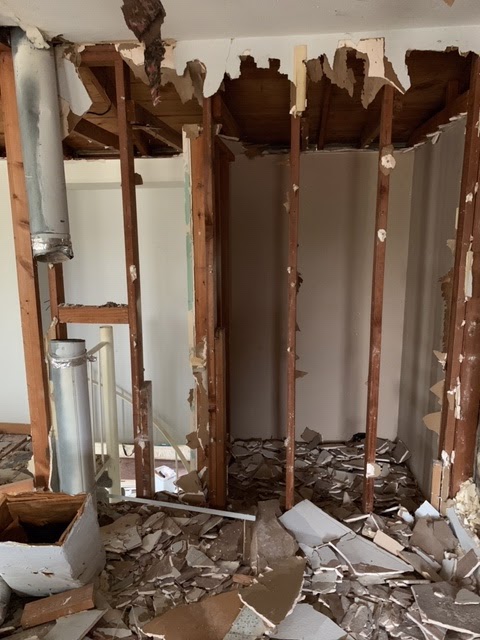
It’s really nice to have a son-in-law who pays attention o my books. Brandon sent this demolition picture with the explanation that they found a dead space next to grandson Sawyer’s closet but, alas, there was no skeleton. Some may remember that my first mystery was Skeleton in a Dead Space; that dead space, like the one in my house, was in the kitchen. Haven’t read it? I think it’s one of my best mysteries. And I love that Brandon saw the connection.

Megan reported about five that grandson Ford and friends were having fun tearing out walls, and she was going home to join them. So demolition proceeds but apparently won’t be total for a couple of weeks. Meantime, what excitement for teen boys.

And the local teen is fishing with his grandfather. He called to ask if the tanks on his uncle’s ranch are stocked. The answer is yes, years ago, but the only way to find out if there are still fish is to go fishing. Jacob said we’d plan a day at the ranch, but then he said, “Juju, when you say tanks, do you mean the ponds?” I told him tank is Texas-speak for pond, and he would have to work on his vocabulary.

For me, a busy day, which I like. When I was in my late teens, I was my father’s secretary—he was administrator of a hospital. I always swore that experience made me a perfect executive secretary, though heaven forbid we should refer to a woman that way today. But I can clear a desk of lots of projects in one big sweep. And I like it that way.

Today I met with a co-conspirator about forming a local group of Better Angels, the national organization that brings together people of opposing political opinions for moderated discussions—no arguing, no proselytizing, just learning from one another. I pretty much secured our church as a meeting place and began to compile a list of interested participants—if you’re interested, please let me know. I set in motion a blog tour for my cookbook, Gourmet on a Hot Plate, and committed to write five blogs by early April. I emailed my accountant that I had finished my tax organizer and was ready to turn it over to him. I straightened out some prescription confusion--always a time-consuming chore as you get left on hold. But the biggie was that I got the edits back on the Alamo manuscript, which means I have a lot to do immediately—dealing with edits, adding some new material, and compiling a complete list of photos. I actually love waking up in the morning and knowing that projects like this are waiting for me.

The mystery I’ve been doodling along goes to one side, though I did make enough notes that I would know where to pick it up. A good day, and I’m a happy camper.

Wednesday, November 28, 2018

Procrastination—who me?


Procrastination: the action of delaying or postponing something. Yep, that’s me. I procrastinated for two days—and it’s so unlike me. I am usually compulsive about doing whatever needs to be done right away. I long ago took to heart the wisdom that you should only touch a piece of paper on your desk once—deal with it then.  Don’t put it in a stack and think, “I’ll worry about that later.” Never the words of Scarlet O’Hara, “I’ll think of it tomorrow,” or “After all,  tomorrow is another day.”

But those are all the things I did for two days. I spent too much time on Facebook and outlets with political news, reading every new opinion, pondering every new development; I spent lots of time paging through Bon Appetit and Southern Living, clipping recipes and planning elaborate dishes I may never cook.

Colin, my oldest child, was my biggest—and nicest—distraction. He arrived Monday in time for dinner, so I spent a good chunk of Monday fixing his favorite casserole. Tuesday morning, I fixed him breakfast—I had several choices for him. And he chose lox and cream cheese. Then we window-shopped Apple watches in the Apple store and had an early lunch at Carshon’s deli. He grew up eating there and now thinks no Fort Worth trip is complete unless he gets one of their Rebecca sandwiches.

By 12:30 Tuesday, he was off to an appointment and then headed home to Tomball. And I procrastinated some more—and napped.

This morning I got up with fire in my belly. I was going to work. And I did—900 words on the Alamo book, mostly about Alamo movies and particularly the classic one John Wayne made in 1959. I am learning such fascinating stuff with this project!

Tonight, a nice dinner with friends Betty and Jean at a restaurant called Righteous Foods, which I think is a terrible name for a restaurant. But the food is good. It’s all “righteous” foods, heavy on grains and vegetables and juices and smoothies. But also their version of a BLT (with a fried egg, of course), a hamburger, and several kinds of tacos. We split an order of salmon tacos, but they were so good I don’t think I’ll share next time. And churros for dessert. A wonderful meal.

Tonight I’ll procrastinate some more—and read. But tomorrow I’ll tackle the subject of books about the Alamo. Life is good. I hope for you too.

Saturday, October 13, 2018

The second battle of the Alamo


I was a recluse today. Just me, Sophie, and that pesky squirrel on the patio. If I had to choose a day to be a recluse, this was a good one. Dark, rainy, stormy this morning. We had those proverbial sheets of blowing rain. Not much thunder, but enough to keep Sophie close to me. This afternoon, the rain stopped, and I even saw sunshine briefly. But there’s more rain tomorrow and then a severe drop in temperature.

I made good use of my day at home alone, worked hard most of the day except for a mid-day break. Spent the day at the Alamo, and I guess it’s time to explain that. In June, a friend was diagnosed with metastatic cancer—someone I knew basically through a close-knit online group of writers but had had one really good in-person visit with. She had a contract with a New York publisher and was working on a book on the second battle of the Alamo. But Debra, the Energizer Bunny, had several other projects going on all the time, and I became part of the squad cheering her on to work on the Alamo book. I knew the story of the second battle, and it’s the kind of history that fascinates me.

When she was hospitalized, she called me one day. “Deb, what can I do for you?” I asked, and she replied, “Write the Alamo book.” I would never ever have wanted that assignment under these circumstances, but it was a project I took on willingly, partly to honor her and partly because it intrigues me. It was the end of summer before the editor, Deb’s partner and literary executor, and I could all reach an agreement. We had danced around the subject as long as Debra was with us. But when she died, we tackled it.

And I have been working on it for about a month now. I’ve sent a draft of the first bit to the editor and gotten back an incredibly helpful critique. Since I’ve written fiction for so long, it’s almost a new experience for me to work with an editor this closely in a back and forth manner, and I’m loving it. I spent most of today putting together a chapter she wants that hadn’t even occurred to me. But it’s all the history I love, and I’m having fun. Problem is, unlike my own fiction, I have a deadline—it was February, but it’s been pushed to May. I think I can do it, but I feel the pressure. So today was a long day at the keyboard.

Tonight, I’m going to continue re-reading a novel about this second battle. TCU Press published it some twenty years ago, and I edited it. But that’s a long time. So far, just barely into it, I’m finding it enormously helpful for atmosphere and period details.

So you might like to know about the second battle of the Alamo. I assume everyone knows about the first. The second was in the early 1900s when a part of the mission compound was in danger of being torn down and replaced by a glitzy hotel. Two women, members of the Daughters of the Republic of Texas, saved the iconic mission. But what began as a collegial relationship soon deteriorated into a definite difference of opinion about which parts of the mission were essential.

The story of the massacre at the Alamo is a man’s story, full of blood lust and courage—and all those qualities we associate with bold men. But the story of the Alamo does not end with that 1836 battle and defeat. Nor is it always a men’s story. The second battle of the Alamo was a women’s battle, fought with the same determination as shown by the original defenders but with different weapons—with words and money and sometimes with outrageous behavior.

Saturday, September 15, 2018

Losing our heroes


If certain “volunteers” have their way, we Texans are going to lose all our heroes. A volunteer committee has been making recommendations to the State Board of Education on “streamlining” teaching. A red flag shot up in my mind—who are these volunteers and why are they qualified to make recommendations?

They did not start quietly. Their first suggestion was that seventh-grade teachers should omit the word “heroic” in referring to the defenders who died at the Alamo. Talk about jumping on a Texas icon! I know they say politics makes strange bedfellows, but I never thought I’d find myself in bed with Greg Abbott and George P. Bush. But they are apparently as outraged as I am.

The explanation was that heroic is a value-oriented word. I’m not sure I understand the concept of value-oriented marketing completely, but it has to do with a customer’s perceived value of an item vs. its real value. All that says to me in this case is that the customer (student?) perceives value in describing the men at the Alamo as heroic. I do—I “perceive” courage and loyalty and determination, all kind of qualities we want our children to learn about.

I think I know part of the thinking—and it’s sort of appropriate in this day and age when harsh immigration policies have demonized our neighbors to the South even more than usual. It’s an effort to counter the stereotype that all Mexicans are evil, and all Anglos are pure and white. But instead of attacking our heroes, why doesn’t the committee teach the whole story—many Mexicanos fought alongside Travis, not against him.

The committee also recommended teachers mention but not teach Travis’ famous “Victory or Death” letter. Where, pray tell, does one draw that line in the sand distinguishing between teaching and mentioning? The board of education apparently didn’t accept that recommendation.

Also on this committee’s hit list: Hillary Clinton and Helen Keller. There is apparently some kind of point system by which candidates are judged. In spite of being the first woman to lead a major political party in a presidential campaign, Hillary fell short. Keller came closer, but she too missed the mark.

You know all those Confederate statues torn down in a frantic effort to erase history rather than learn from it? This is just another way of tearing down statues. I for one think those volunteers need to get a life.